
Five Corners Previous Resident Sources
The best source depends on the period and on what must be proved. Current parcel tools identify stable land. Recorded documents name parties to legal instruments. Printed directories and telephone books may place a listed person at an address, while court, map, and newspaper sources can explain a transfer, death, changed road name, or rebuilt site. No single record is a complete list of previous residents.
| Source | Years It Covers | Where Held | What It Shows |
|---|---|---|---|
| Assessor PIC and MapsOnline | Current system | Clark County Assessor and GIS | Parcel, situs, legal description, sales, and map layers |
| Landmark Web | Online cutoff not confirmed | Clark County Auditor | Recorded parties, dates, filing numbers, and legal clues |
| Digital Archives land records | 1998–2021 | Washington State Archives | Party, addition, year, and selected image records |
| Vancouver city directories | 1907–2008, with gaps | Washington State Library | Listed names, addresses, and businesses by edition |
| Vancouver telephone books | 1944–2010, with gaps | Washington State Library | Subscriber and address clues |
| Clark County directories | Listed years from 1918–1934 | Washington State Library | County-level historical listing leads |
| CCHM historical resources | Mixed | Clark County Historical Museum | Newspapers, images, maps, oral histories, and place context |
| Vancouver Sanborn maps | 1892 | Library of Congress | Regional building and street context, not an occupant roll |
Begin in PIC for any modern address. Use Landmark and the Digital Archives for late twentieth-century and newer transfers. For an early or mid-century household, search directories around a deed date, then add newspapers, maps, and court records only as the facts call for them.
Anchor Five Corners Address History
A current Property Information Center card can translate a modern Five Corners address into a parcel number, situs, and abbreviated legal description. Those fields are more stable than a postal city or neighborhood label. Save the unit, parcel or PAN, map location, subdivision or plat clue, and retrieval date before looking for any past resident.
Five Corners is an unincorporated Census-designated place. An older source may say Vancouver, Orchards, a rural route, SR-503, 117th Avenue, NE 76th, NE 94th, NE 119th, or a legal subdivision. Compare the city-limit, ZIP, neighborhood, and historic aerial layers in MapsOnline. Do not force those labels into one boundary.
Note: A unit number or mobile-home legal description may be essential when several households share one Five Corners street address.
Five Corners Land Records Online
The Washington State Archives Clark land-record collection covers 1998 through 2021 and reports 2,674,808 records. Search fields include Party Last or Company, First, Middle, Soundex, Party Type, Keywords or Addition Name, and Year From or To. The collection is open for research, though the current year may be incomplete and some images can be absent for confidential information.
Use this series as a cross-check, not as a complete chain of previous residents. Record the party role, document type, filing number, record date, parcel or addition, image status, and filters used. A party may be an estate, lender, trustee, business, or attorney. The indexed event is not proof that the party occupied the parcel.
The archive interface shows the party, addition, and year controls. Open the Five Corners recorded-land search before consulting this capture.
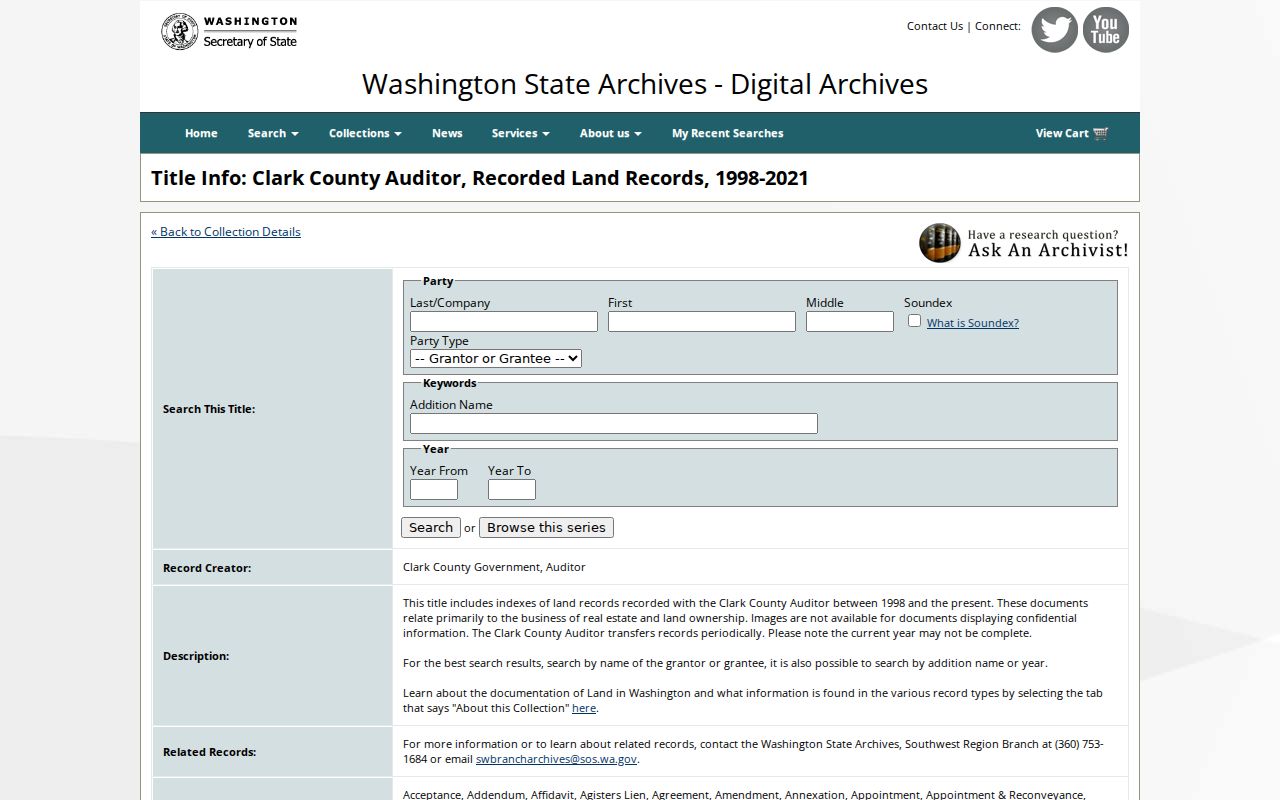
The fields help narrow a parcel-era search while preserving the gap between a recorded party and an actual former occupant.
Trace Clark County Owners Backward
A chain of title is the documented sequence of interests in a parcel. Start with today's parcel card, then verify every link in the Clark County Auditor Landmark index. Match the parcel or legal description, not merely a similar surname. Landmark offers name, document, parcel, filing number, record date, legal, book/page, and other search routes.
- Copy the parcel number, situs, map position, and legal description from PIC.
- Find the current transfer instrument in Landmark. Confirm the parcel or legal description and note each party role.
- Search the seller, or grantor, as a grantee to find that party's earlier acquisition of the same land.
- Repeat the match backward. Cross-check records dated 1998–2021 in the State Archives collection.
- When online coverage ends, contact the Auditor for index, microfilm, mail, in-person, noncertified, or certified-copy options.
- Grantor
- The party transferring an interest in a recorded instrument.
- Grantee
- The party receiving that interest.
- Chain of title
- The linked sequence of recorded transfers for the same land.
- Legal description
- The lot, block, subdivision, or other land description that can remain useful after a street label changes.
Landmark images are not certified copies. The Auditor's document request page explains in-person and mail service. Noncertified copies cost $1 per page; a certified copy costs $3 for the first page and $1 for each added page. Confirm current terms before ordering.
Match Five Corners Directory Years
After each transfer date, look for the next available Vancouver or Clark County edition. The Washington State Library lists Vancouver city directories from 1907 through 2008 with substantial gaps, telephone books from 1944 through 2010 with gaps, and Clark County directories for selected years from 1918 through 1934. These volumes are mainly on-site resources, and State Library public service changed after July 1, 2025, with limited appointment access in the current notice.
A listed name may be a householder, individual, business, or telephone subscriber. Record the edition, title, publisher, page, name and address exactly as printed, listing type, business label, phone if printed, geographic label, and any abbreviation. No public Five Corners sample directory page was found, so do not invent a resident entry.
The available year runs appear on the Washington State Library directory page. The captured page below confirms the collection and its access context.
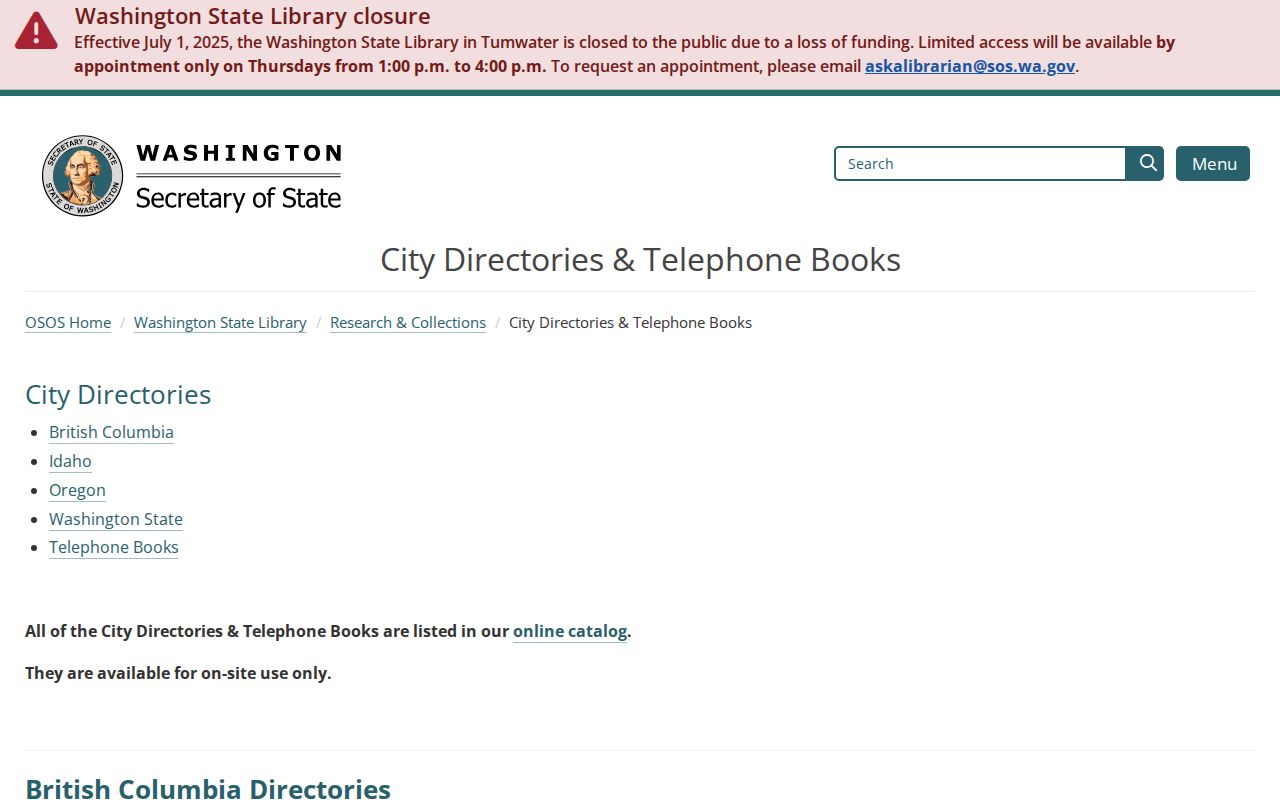
The holdings supply dated address clues, but each printed listing still needs comparison with the parcel and deed chain.
Five Corners House Research Routes
The Clark County historic-preservation research guide points house researchers toward Auditor deeds, Vancouver Community Library newspaper microfilm, city directories, newspaper articles, photographs, Sanborn and Metsker maps, donation-land-claim maps, the Clark County Genealogical Society, and the Clark County Historical Museum. Historical contact or fee details in that guide should be checked against the live institution before a visit.
The Clark County Historical Museum research service asks for exact names, dates, locations, prior work, intended use, and budget. Its page says one courtesy hour is free, later work and reproductions may be charged, and normal research may take four to six weeks or longer. New requests are currently paused because of volume, so use its electronic resources and recheck status rather than assuming staff can begin at once.
The museum's form makes the needed level of detail clear. Review the Five Corners house-history request route with the capture.
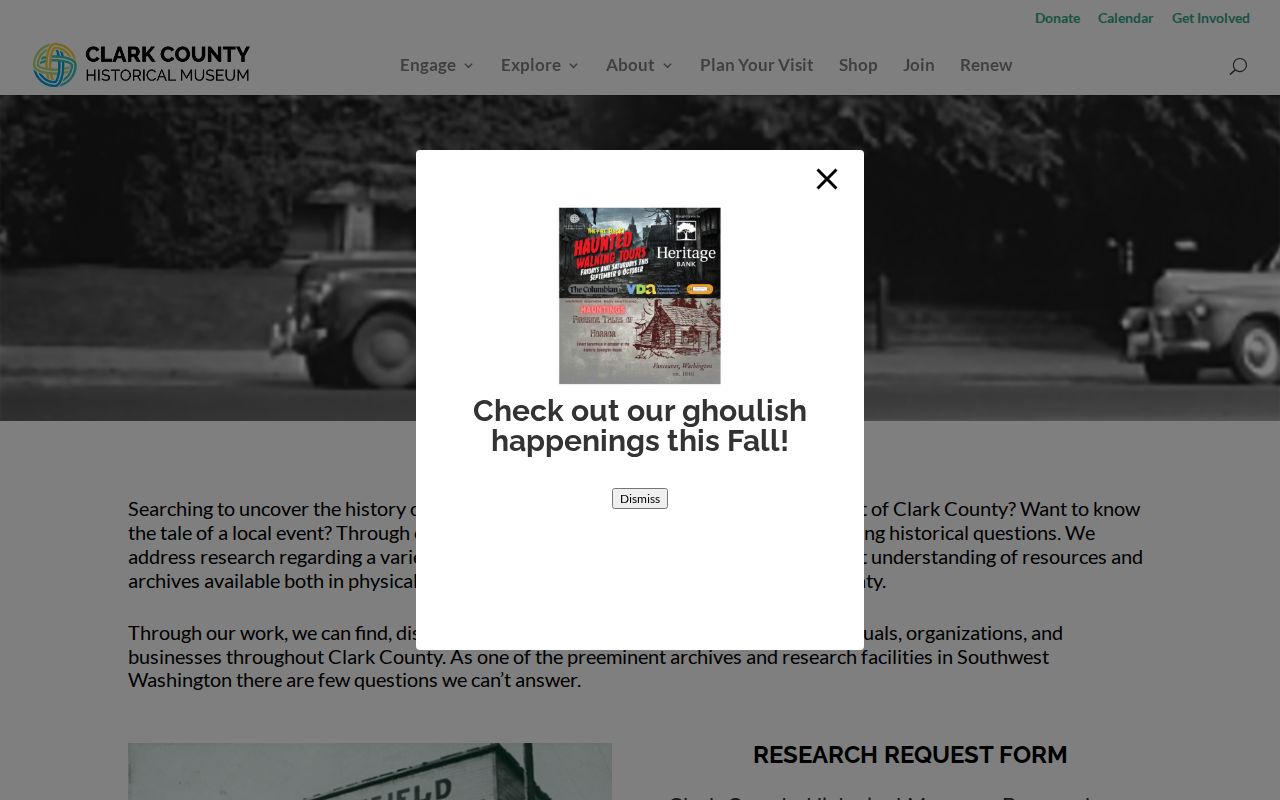
The form rewards a narrow address, name, and date range, which is exactly what a parcel-led history should produce.
Five Corners Records Before 1890
The February 25, 1890 Clark County courthouse fire explains a hard stop in some previous-resident trails. The county courthouse National Register nomination says the fire destroyed court and administrative material, including Superior, District, probate, sheriff, school, surveyor, mortgage, deed, and tax-receipt records reaching back about forty years. A missing nineteenth-century instrument may reflect real loss, not a spelling error.
When the deed chain stops, switch to surviving newspapers, directories, church or family material, maps, probate clues, and archival collections. Mark the gap. The fire does not justify inserting an unproved owner. Later rural-to-suburban change also means that the right clue may be a farm, tract, subdivision, or old road rather than the modern Five Corners address.
Corroborate Five Corners Past Residents
CCHM's electronic resources report more than 17,093 digital images, six years of the Vancouver Independent from 1876 through 1888, more than 200 oral histories reaching into the 1950s, Mapping Clark County material, and a Vancouver Area Chronology covering 1784 through 1958. Search names, road variants, subdivisions, and nearby institutions around each confirmed deed or directory date.
The 1892 Vancouver Sanborn set has nine public-domain sheets. It is regional built-environment context, not an early Five Corners occupant map, because coverage of the modern CDP is not established. A map or newspaper can support a changed place name or building timeline, but it should not replace a parcel or dated listing.
Confirm Five Corners Previous Residents
Owners are only part of the household trail. A directory can show who was listed at an address in one edition, and a census can show a household in its enumeration period. Pair the nearest available directory before and after a census or deed date. The full holdings and reading method belong to the Five Corners city directory page.
- Record the deed date and exact legal parcel match.
- Check the closest directory editions on both sides of that date.
- Compare an available census schedule by household, place label, and enumeration geography.
- Use newspapers, obituaries, cemetery records, or public probate material to test moves, deaths, heirs, and estate transfers.
- Write separate findings for owner, recorded party, listed occupant, and confirmed resident.
A criss-cross directory is arranged from address to listed name, but no confirmed online Five Corners criss-cross database was found. Obituaries and probate files can explain the end of a trail, though court confidentiality and access rules still apply.
Lawful use. Research Five Corners previous residents for house history, family history, estate work, or personal curiosity. Never use a record trail to harass, track, intimidate, or harm a living person.