
Five Corners Directory Collections
The strongest organized shelf is the Washington State Library's Vancouver and Clark County collection. It is a proxy, not a Five Corners municipal series. The editions can place a listed person, firm, or phone at a dated address when the publisher included the unincorporated edge of Vancouver. Coverage has gaps, so an absent year or name should be logged as a limit rather than read as a move.
| Collection | Years | Where Held | Access |
|---|---|---|---|
| Vancouver city directories | 1907 to 2008, with gaps | Washington State Library | Catalog and on-site collection |
| Vancouver telephone books | 1944 to 2010, with gaps | Washington State Library | On-site listing research |
| Clark County directories | 1918-19, 1921, 1928-29, 1931, 1934 | Washington State Library | County-level historical lead |
| Images, newspapers, oral histories | Collection-specific | Clark County Historical Museum | Online and staff-mediated |
| Vancouver Sanborn maps | 1892, nine sheets | Library of Congress | Online regional context |
The Vancouver run includes 1907-09, 1911-19, 1921, 1928-29, 1931, 1934, 1938, 1940, selected 1950s and 1960s volumes, most years from 1967-84, and later editions through 2008. Check the State Library holdings for the exact year.
Five Corners Directory Jurisdiction
Five Corners is a census-designated place and unincorporated community. It has no city clerk, city archive, or standalone municipal directory. Older publishers could use Vancouver as the postal city, Orchards as a locality, a rural route, or a road name unlike today's form. County planning records also place the area amid changing service and annexation lines.
Search a surname with Vancouver and Orchards, then test NE 76th, NE 94th, NE 117th or SR-503, and NE 119th. A parcel and legal description can translate an old label. Modern address tools are covered in the Five Corners street directory.
Note: A Vancouver heading in a city directory does not prove that the listed address stood within Vancouver city limits.
Reading Five Corners Directory Entries
No public scan of a specific Vancouver or Five Corners entry was found. Do not invent one. Photograph the title page and abbreviation key, then record every visible field from the real entry. Publishers changed layouts, symbols, boundaries, and household groupings.
| Field | What to Preserve |
|---|---|
| Edition | Year, title, publisher, page |
| Name | Spelling, initials, household notation |
| Listing | Address, phone, occupation, firm, type |
| Context | Nearby entry, geographic label, source URL |
| Marks | Abbreviations and householder symbols |
A listed phone can belong to a subscriber or firm. An occupation is printed text, not a current fact. A person can be missing due to timing, an unlisted number, spelling, or boundaries.
- Criss-cross directory
- An address-first section arranged by street and number.
- Householder index
- A list that groups a principal listing at an address.
- Abbreviation key
- The publisher's legend for shortened streets, roles, firms, and marks.
Five Corners Directory Library Access
State Library service changed after July 1, 2025. Its notice describes limited appointment access, so verify service before travel. The books are collection materials, not an online person search. Bring a narrow list of names, years, and place variants, and consult surrounding editions.
The State Library directory page shows the access context pictured below.
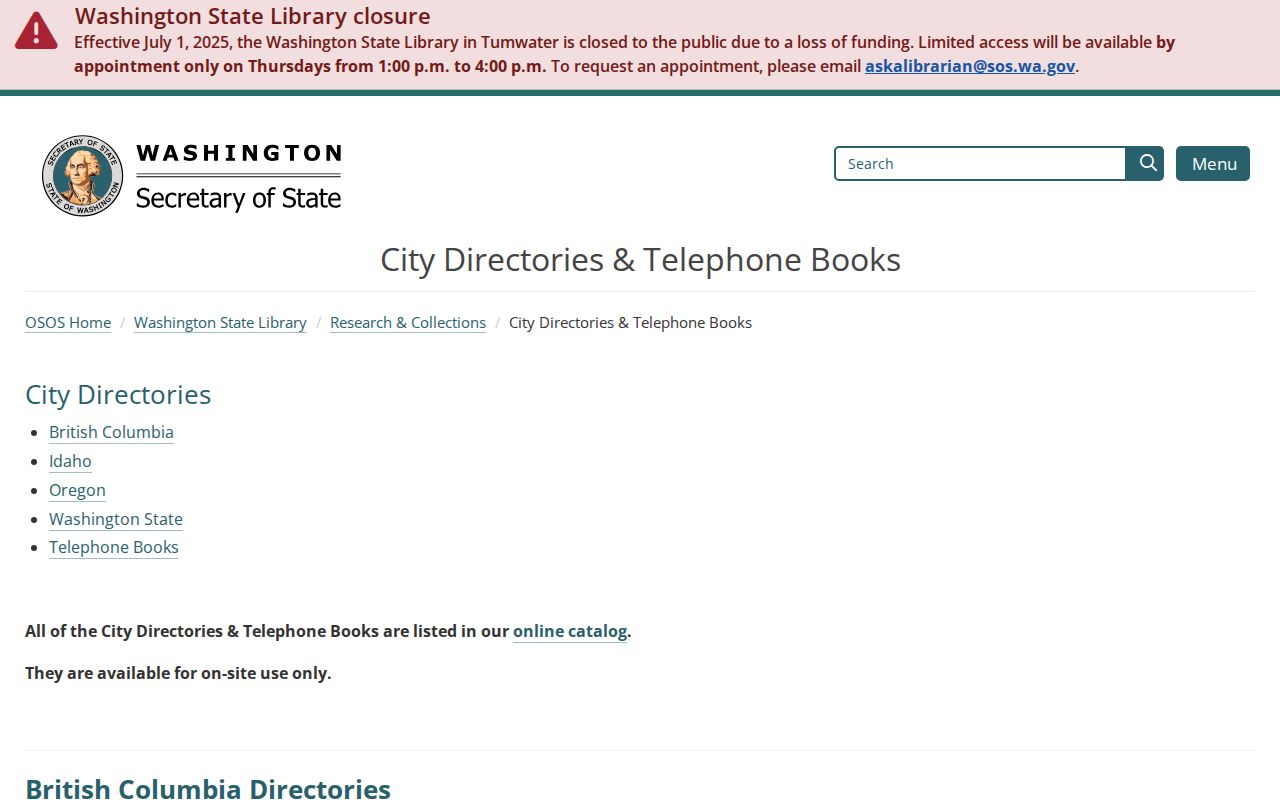
The capture helps confirm holdings and on-site restrictions before a year-by-year search.
Fort Vancouver Regional Library is a local bridge. The county preservation guide points to Vancouver Community Library microfilm of The Columbian back to 1890, useful between directory years.
Five Corners Directory Museum Research
The Clark County Historical Museum asks for a detailed question, names, dates, locations, prior work, intended use, and budget. One courtesy staff hour is described as free. Further work, reproductions, and usage may carry charges. Lead time is at least four to six weeks and can extend for months.
New requests are paused because of volume. Check the CCHM research page first.
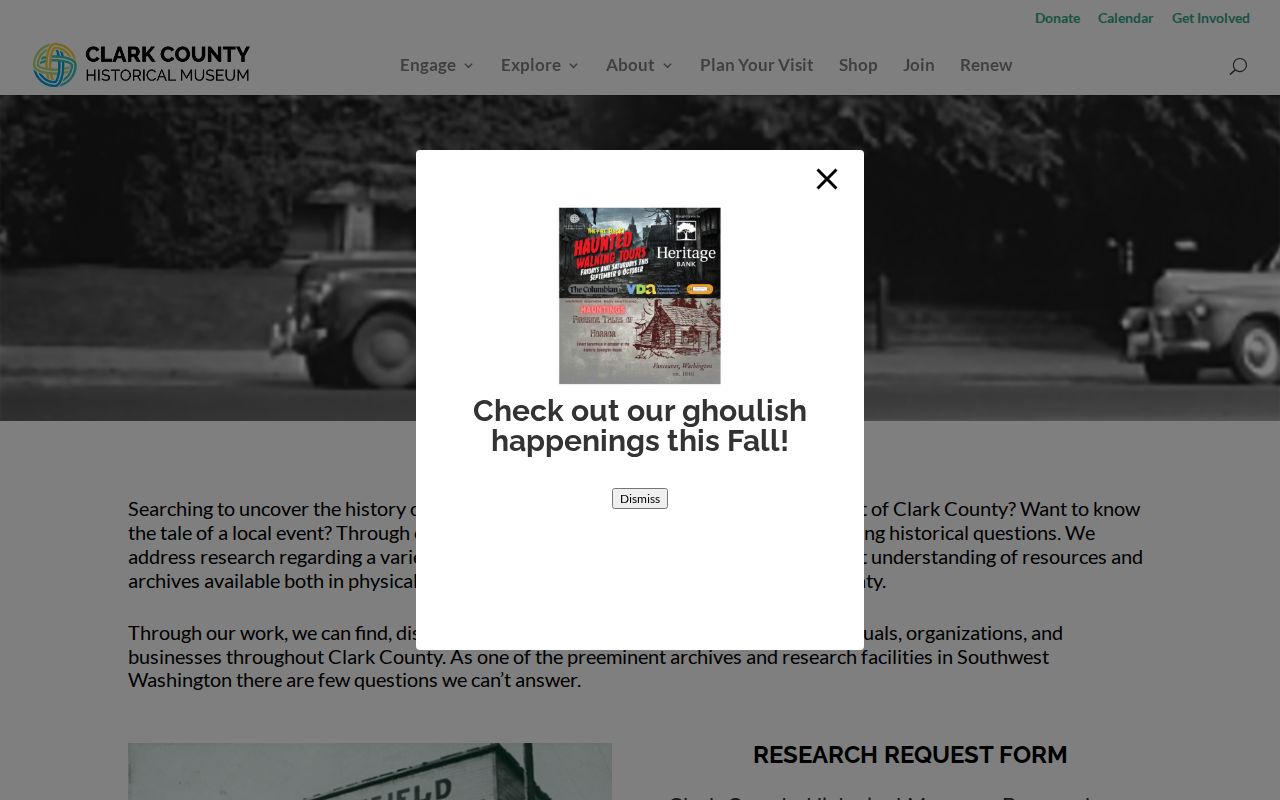
The form shows why a street, short date window, and known name beat a request for every resident.
Collection access is supervised. Fragile or sensitive items can be restricted, photography follows museum rules, and copyright applies.
Five Corners Directory Digital History
CCHM's electronic resources add evidence around the printed city directory. The museum reports more than 17,093 digital images, six years of the Vancouver Independent from 1876 through 1888, more than 200 oral histories reaching to the 1950s, Mapping Clark County maps and aerials, and a Vancouver Area Chronology spanning 1784 through 1958.
The CCHM electronic collections provide the paths shown here.
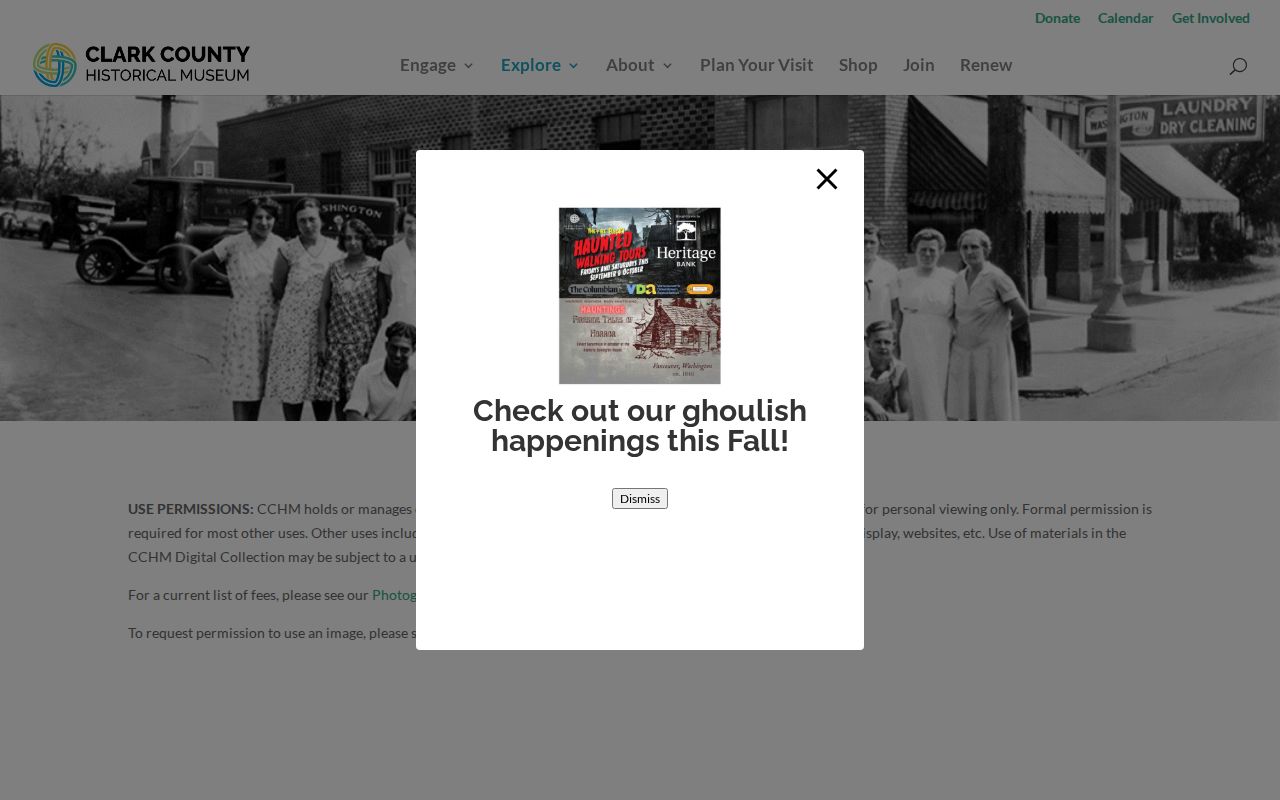
These sources may explain a move, firm, road label, or event, but each item needs its date, title, and identifier.
The 1892 Vancouver Sanborn set is a regional map time capsule. Its nine sheets do not establish modern Five Corners coverage and are not a resident roll.
Five Corners Telephone Directory Years
Vancouver telephone books fill some directory gaps. Runs include 1944-55, 1957-58, 1961-62, 1964-65, 1967-72, 1974-2004, and 2006-10. A book can supply a subscriber name, number, and printed address near a target date.
It cannot establish every household member or year-long residence. Compare the prior and next book, then test a dated newspaper, directory, deed party, or map reference.
Note: Record year and page because a telephone listing can persist after a move or omit an unlisted household.
Fire Gaps in Five Corners Records
The February 25, 1890 Clark County courthouse fire destroyed roughly forty years of court and administrative material, including probate, deed, mortgage, tax, sheriff, school, and surveyor records. That explains why a family can appear in a newspaper or later city directory while an expected county file is absent.
When the trail stops, try surviving newspapers, church and family material, maps, directories, later probate files, and nearby county leads. Mark the gap instead of guessing a person or transaction.
Trace Five Corners Directory Families
A sound chain follows a name across editions while keeping each claim narrow. Pair city directories with census years, since the books can fill some gaps between federal counts. Use newspapers and official records to explain a change.
- Choose the first likely directory year and record the printed name.
- Check the prior and next available editions, noting changes.
- Try an address-first section when one is present.
- Compare the nearest census, newspaper, and lawful historical record.
- Save page citations and label each claim precisely.
Disappearance can mean a move, death, gap, new spelling, postal label, or unlisted household. If the goal changes to a current name, use the Five Corners resident lookup and retain official limits.
Keep four claims separate throughout the chain. A directory says a publisher listed a person or household. A deed says a party took part in a recorded instrument. A parcel card describes a tax parcel and related fields. A newspaper may report an event or social connection. Agreement among dated sources makes the history stronger, but none should be rewritten as a broader fact than its own record supports.
County sources offer several fallbacks when the city-directory shelf has no target year. The State Archives holds series-specific historical records, the Auditor supplies deed indexes and copies, and CCHM preserves newspapers, photographs, oral histories, maps, and chronology. Ask for the exact series and date range. Save a citation even when the result is negative, since the known gap may guide the next search.
Corroborate Five Corners Directory Names
A directory name becomes more useful when a second dated source explains why it appears. The Clark County Historic Preservation guide identifies deed records, city directories, The Columbian microfilm, photographs, Sanborn and Metsker maps, and donation-land-claim maps as research tools. It also names the Clark County Genealogical Society as a specialist resource. Select the source by question. A deed may establish a recorded party, a map may place a road or structure, and a news notice may date a marriage, death, firm opening, or public event.
Write down the form of the place name before searching. Five Corners material may sit under Vancouver, Orchards, a rural route, a subdivision, a tax lot, SR-503, 117th Avenue, or road segments such as NE 76th, NE 94th, and NE 119th. Try the variant that fits the target year, not every term at once. When the old address does not match the modern street form, a current parcel's abbreviated legal description may connect the directory listing to a plat, deed index, or historical map.
Do not merge the records into one biography. Cite the city directory for its printed listing and the corroborating source for its own fact. If the sources conflict, preserve both dates and wordings. A later directory may reflect a corrected spelling, a move, a new postal label, or a publisher's different boundary. The conflict is a reason to search another edition, not permission to choose the more convenient entry.
Note: A dated name and address from two independent sources is stronger than repeated copies of the same publisher's listing.